%20(2).svg)


How Does a Content Distribution Engine Work? (Full Architecture, Costs & Real Numbers)
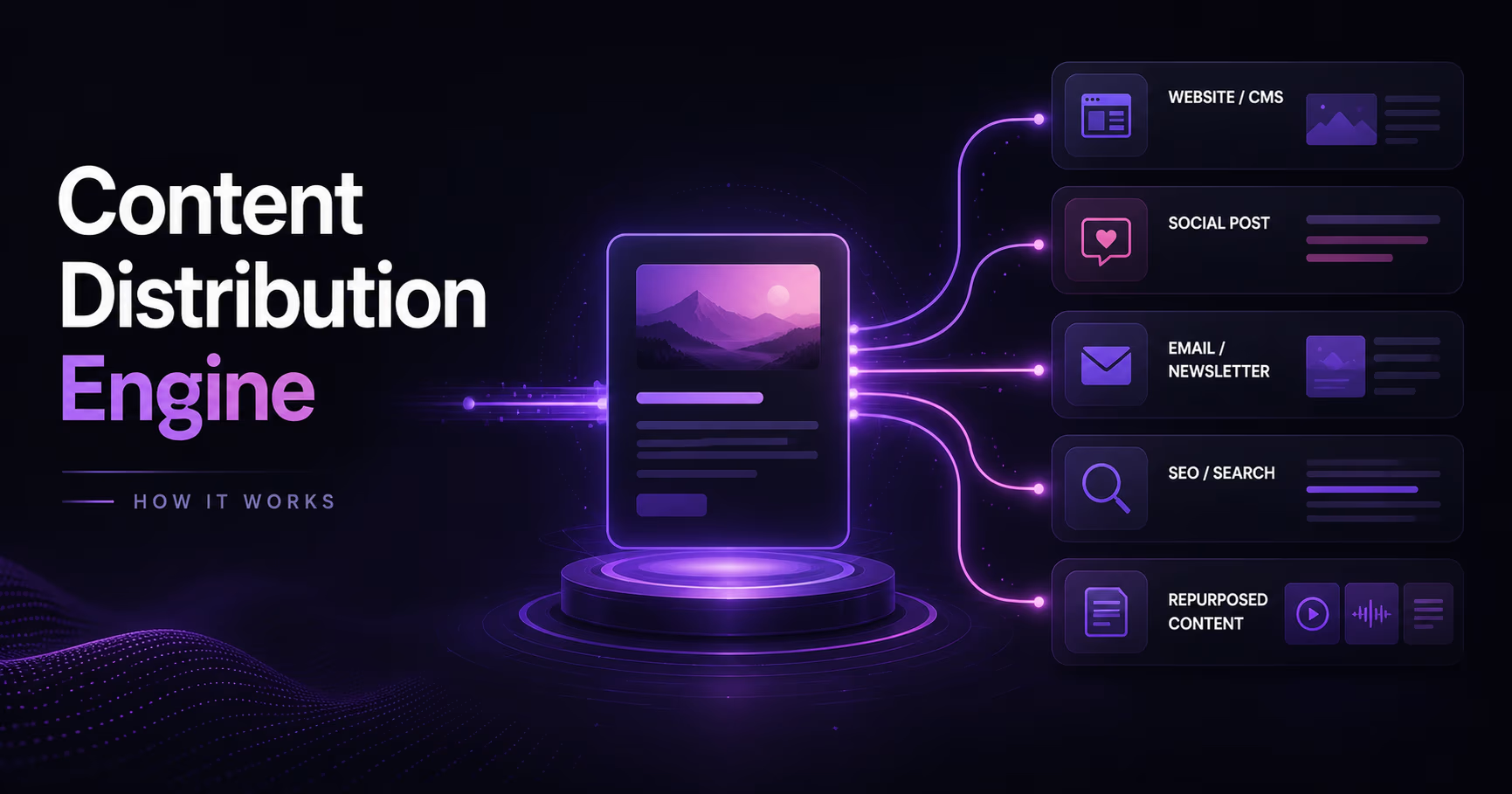
A content distribution engine is an automated pipeline that researches topics, generates SEO-optimized articles, publishes them to your website CMS, and distributes them to social channels — on a schedule, without a human writing each piece. The architecture has four stages: research agents gather source material, an LLM generates the draft under a strict prompt contract, an automation layer publishes to the CMS with metadata and internal links, and a distribution layer repurposes each piece for LinkedIn and other channels.
We built and operate one — it took a new site from 0 to 4,600+ organic impressions in about 30 days. This playbook explains exactly how the machine works, what it costs, and the expensive lessons about quality that most vendors won't tell you.
The four-stage architecture
| Stage | What happens | Typical tooling | Failure mode to guard against |
|---|---|---|---|
| 1. Research | AI agents pull sources, stats, and angles for a predefined topic map | Perplexity / web search APIs + n8n or Make | Thin topics nobody searches for |
| 2. Generation | LLM writes the article under a strict contract: structure, tone, keyword targets, answer-first intro, FAQ block | Claude / GPT with JSON-schema output | Generic AI prose with no expertise signal |
| 3. Publishing | Automation creates the CMS item — title, slug, meta description, categories, rich text, schema — and publishes | Webflow Data API v2 (or WordPress REST) | Missing metadata, duplicate slugs, no internal links |
| 4. Distribution | Each article is repurposed into social posts and queued to LinkedIn and other channels | n8n / Make + channel APIs | Posting links with no native-format hook |
Every stage runs on the same automation backbone — the engine is really just a disciplined n8n/Make pipeline with LLM steps and guardrails, the same pattern as any AI workflow implementation.
Inside the machine: contracts, publishing, and distribution
The prompt contract is the product
The difference between an engine that builds authority and one that produces spam is the generation contract. Ours enforces: an answer-first opening paragraph (quotable by AI search), one primary keyword with 2–3 secondary targets, at least one comparison table, a FAQ section with question-shaped headings, internal links to two relevant pages, and a hard ban on unverifiable claims. Output is structured JSON, not free text:
{
"title": "...",            // ≤60 chars, keyword front-loaded
"slug": "...",
"metaDescription": "...",  // ≤160 chars
"categories": ["..."],
"sections": [
  {
    "heading": "...",
    "html": "..."
   }
],
"faq": [
  {
    "q": "...",
    "a": "..."
  }
],
"internalLinks": [
  {
    "anchor": "...",
	"path": "/..."
  }
]
}
Structured output lets the publishing stage map fields directly into the CMS with zero manual cleanup.
Publishing without a human
The pipeline upserts into Webflow CMS by slug — create if new, skip if exists — sets every SEO field, attaches categories, and publishes the item. The same upsert-by-key discipline from our Airtable–Webflow sync guide applies: no stable key, no engine.
Distribution is where most engines stop short
Publishing an article is step three, not the finish line. The engine drafts a native LinkedIn version of each piece — hook first, no bare link dump — and queues it. One article becomes a blog post, a LinkedIn post, and structured FAQ data for AI search engines to cite. That last audience matters more every month: engines structured this way get quoted by ChatGPT and Perplexity, which is the core of GEO.
Want to apply this to your setup?
Costs, results, and the honest lessons
What it costs
Our Content Distribution Engine runs from $47/month (one article per day, one social channel) to $99/month (up to three articles daily, multiple channels, AI research agents), with a one-time setup of $500–$1,500 depending on customization. Self-building the same pipeline costs roughly: LLM API $20–100/mo, automation platform $0–50/mo (n8n self-hosted to Make), plus the real cost — the weeks of prompt-contract engineering and publishing-pipeline debugging.
What it achieved — and what it didn't
The engine took a fresh site from zero to 4,600+ organic impressions in ~30 days and got content indexed and cited by AI crawlers at scale. But here's the lesson most vendors skip: volume without topic discipline attracts machines, not buyers. Our first iteration generated technically-polished articles on topics real humans don't search for — impressions without clicks. The fix wasn't better writing; it was pointing the research stage at query data (Search Console striking-distance terms, question-shaped long tails) so every generated piece targets demand that actually exists. Engine + keyword discipline is the whole game.
Q: How does a content distribution engine work?
A: It chains four automated stages: AI research agents gather sources for a topic, an LLM generates the article under a strict structural contract, an automation layer publishes it to your CMS with full SEO metadata and internal links, and a distribution layer repurposes it for social channels — all on a schedule.
Q: How much does a content distribution platform cost?
A: Managed engines like ours run $47–$99/month plus a $500–$1,500 setup. Enterprise content-distribution platforms often charge $1,000–$3,000+/month for similar output. Self-building costs less in tools (~$50–150/mo) but far more in engineering time.
Q: Does AI-generated content hurt SEO?
A: Volume alone can — Google assesses sitewide quality, and mass content nobody engages with becomes a liability. Engines work when generation is constrained by a quality contract, topics come from real query data, and humans gate what ships. Ours includes review gates and topic discipline for exactly this reason.
Q: Can it publish to Webflow specifically?
A: Yes — Webflow's Data API v2 supports programmatic item creation with full SEO fields, categories, and instant publishing, which makes it one of the best CMS targets for automated content pipelines.
Want the engine without building it?
See Content Distribution Engine plans and pricing — or if you'd rather own a custom pipeline, we build them as part of our AI workflow implementation and Webflow automation services. Tell us about your project.
Related: Webflow MCP: Running Your Site with Claude · 7 Ways to Automate Webflow with AI