%20(2).svg)



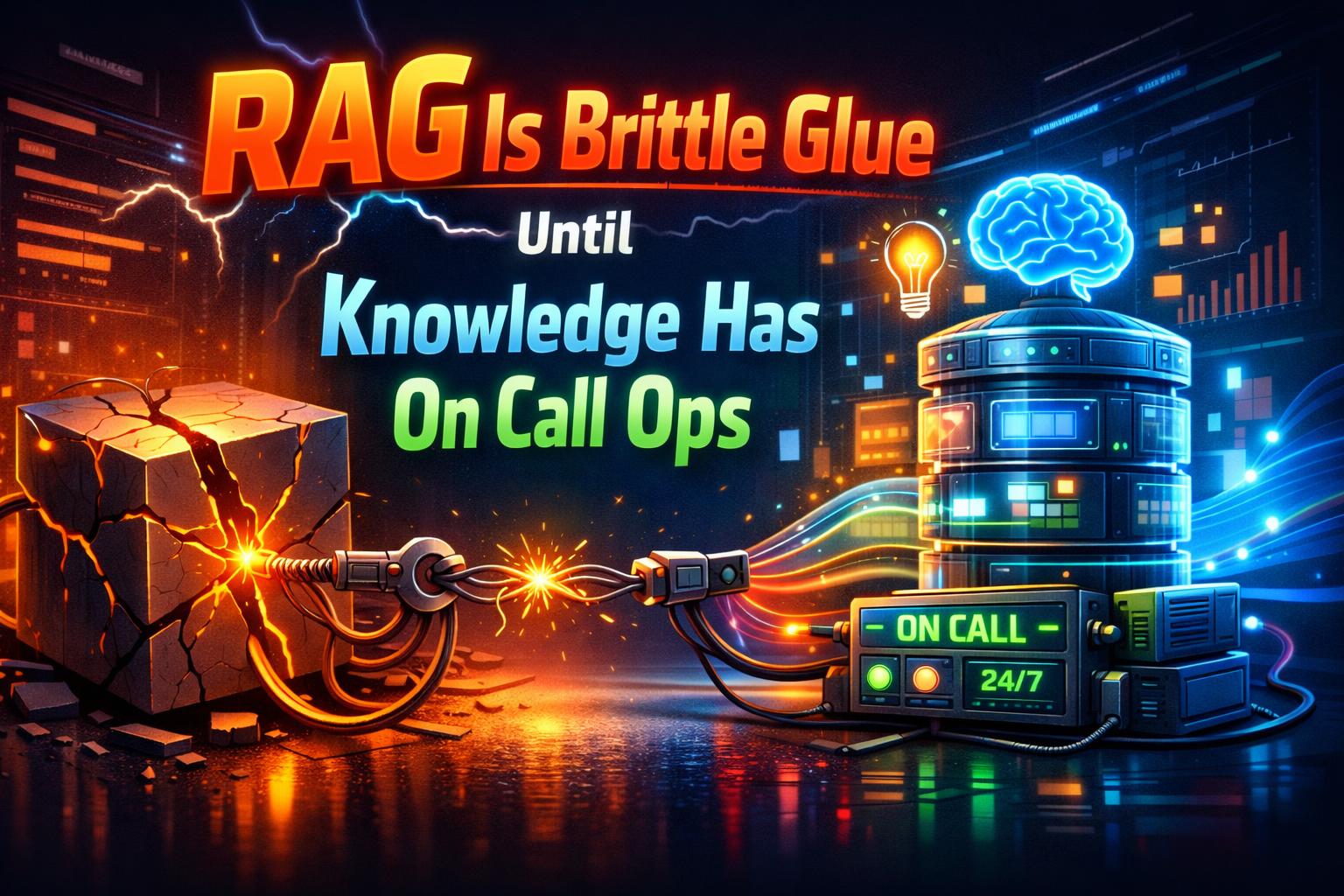
Retrieval Ops Turns AI Assistants Into Accountable Systems
Everyone loves the idea of “one more agent” wired into the stack, right up until the first time it returns a confident answer sourced from a stale page, a half-migrated doc, and an internal link that now redirects to a 404. Then the real work starts: not prompting, not model selection, but figuring out which chunk of text actually got embedded, when, under what schema, and why the retrieval layer is acting like yesterday’s index is still gospel.
Retrieval is politics.
Pinecone looks like infrastructure you can ignore, which is exactly why it becomes the quiet choke point in modern AI workflows: you don’t feel it while you’re prototyping, and then production traffic turns your “simple semantic search” into a pipeline that needs versioning, rebuilds, backfills, and incident response.
Welcome to ops.
The workflow shift is subtle but brutal. Teams used to treat search as a feature; now retrieval is a dependency with a release cycle. You’re not just storing vectors, you’re managing ingestion jobs, embedding model upgrades, namespace boundaries, and the awkward reality that “delete” doesn’t mean “gone” when compliance asks for provable removal across derived representations.
Audit or regret.
The practical pattern emerging is index-as-artifact: every ingestion run gets a build ID, every embedding model bump triggers a planned reindex, and every app response logs the retrieval trace so someone can reconstruct how the answer happened without séance-level guesswork. This also forces uncomfortable governance decisions: which sources are allowed in, who approves schema changes, and what “freshness” actually means when marketing edits pages hourly and support docs lag by weeks.
Decide the truth.
Pinecone isn’t the magic. It’s the receipt printer for your knowledge pipeline, and experts are finally admitting they need receipts.
Keeping Retrieval Fresh With Reindexing And Traces
Mara runs platform at a startup that swears it’s “AI-first,” which mostly means her pager is now attached to the search box.
Her morning starts with a Slack thread: Sales is furious because the assistant quoted last quarter’s pricing. Support is furious because it invented a policy. Product is calm, which is how she knows they haven’t looked yet.
She opens the trace logs. The model didn’t “hallucinate” in the mystical sense. It retrieved a perfectly real chunk from an old PDF that should’ve been retired, plus a Confluence page that was copied during a migration and never updated. Same title. Different truth. Retrieval ranked it higher because the old page had more repeated keywords. Of course it did.
So she checks Pinecone. There are three namespaces nobody remembers creating. Two ingestion jobs are still running on a cron schedule from the prototype. The embedder was upgraded last week, but only half the corpus got re-embedded before the job hit a rate limit and quietly died. Quietly. That’s the part that hurts.
The failure mode is almost always the same: everyone treats the index like a database table, not like a build artifact. They update sources and assume the vectors “follow along.” They don’t. Vectors are stubborn. They’re snapshots with muscle memory.
By noon, Mara has a plan that feels less like ML and more like release engineering. New build IDs per ingestion run. A hard rule that an embedding model change is a reindex, not a “we’ll get to it.” Deletion requests wired to both source-of-truth and vector store, with verification, because compliance doesn’t accept vibes.
And then the uncomfortable question: who owns freshness? Docs? Marketing? The team that’s on call when an outdated policy becomes an incident?
She ships a fix: retrieval traces attached to every answer, visible to internal users, so someone can point at the exact chunk and say, “This is wrong,” instead of blaming the model like it’s weather.
It’s not magic. It’s maintenance. It’s receipts. And it’s the difference between an assistant and an expensive rumor machine.
Turn this playbook into a working system
Govern Retrieval Like A Product With Owners And Receipts
Here’s the part nobody wants to admit: a lot of “RAG failures” aren’t engineering bugs, they’re org design. We keep trying to fix retrieval with better embeddings and clever rerankers, while the real issue is that the company has multiple competing truths and no one wants to referee. The vector index just makes the conflict visible, then ships it to customers at machine speed.
If we’re serious, we stop pretending the index is neutral. We treat it like a product surface with editorial control. That means someone is accountable for what gets retrieved, not just what gets written. It also means saying no. No, the assistant cannot ingest every folder, every half-migrated wiki, every PDF someone uploaded in 2019. “More context” is how rumor becomes policy.
A practical move I’d make in our own business is to create a Retrieval Change Board, not because meetings are fun, but because the alternative is silent drift. Two rules: any new source needs an owner and an expiry policy, and any schema change ships with a rollback plan. Freshness becomes an SLA, not a vibe. If marketing wants hourly edits to count, cool, then they fund hourly ingestion, evaluation, and on-call coverage. If they don’t, the assistant is allowed to say, “I’m not current enough to answer that.”
There’s a business hiding here, too. Build a tool that sits next to Pinecone and acts like a release manager for knowledge. Call it Index Ledger. It assigns build IDs, tracks which docs became which vectors, blocks partial re-embeds from reaching production, and generates deletion attestations that legal can actually sign off on. The pitch isn’t “better search.” It’s “fewer incidents and provable receipts.”
The contrarian take is simple: the winning assistants won’t be the ones that know everything. They’ll be the ones that can prove what they know, when they learned it, and who signed their homework.