%20(2).svg)



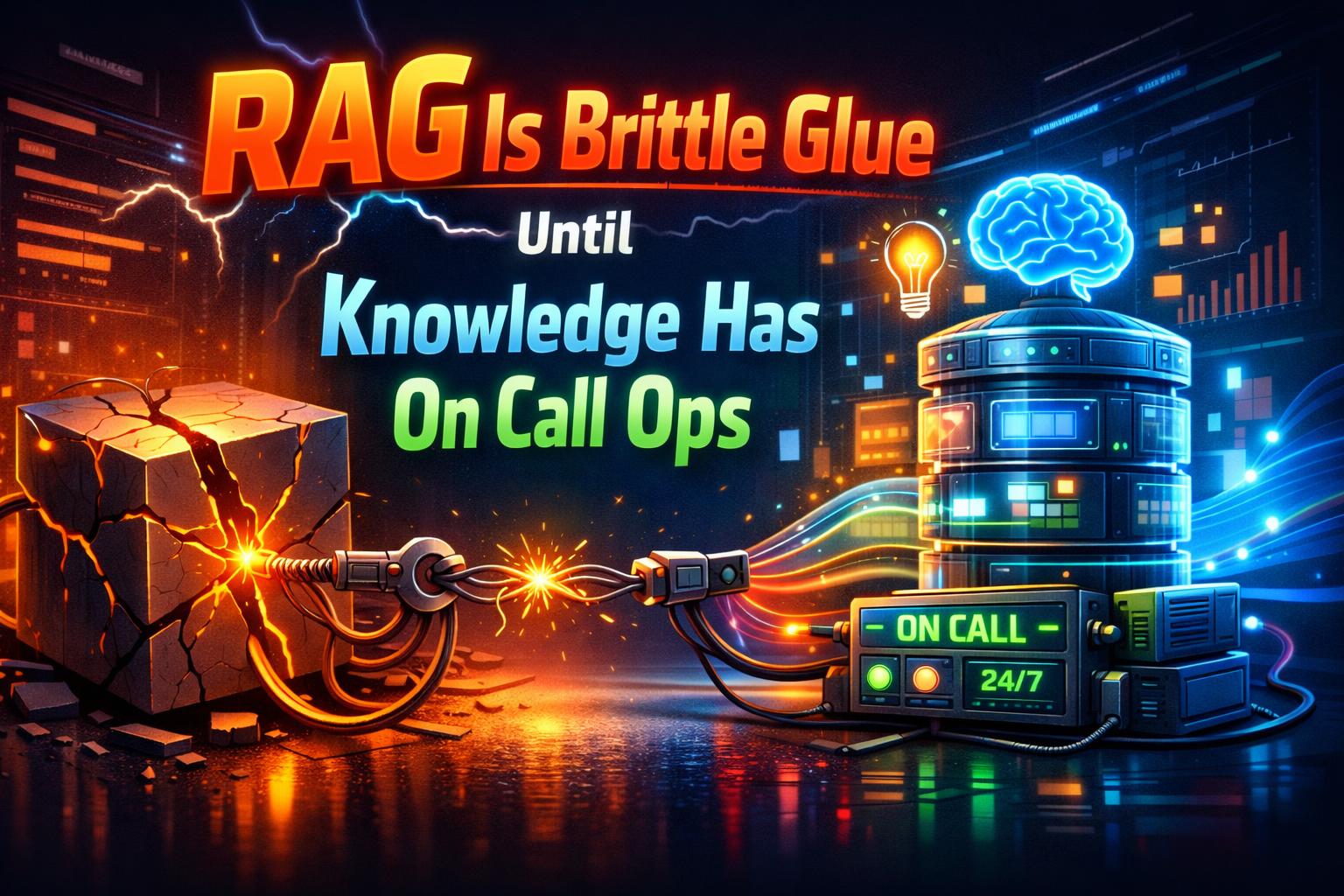
Retrieval Is an On Call System Not a Knowledge Base
Your model answers look fine until someone asks where the answer came from, and suddenly you’re explaining “it was in the embedding index” like that’s a provenance strategy instead of a shrug with extra steps.
That never holds.
Pinecone sits right in the uncomfortable middle of RAG: it makes retrieval fast enough to ship, then quietly forces you to admit your knowledge isn’t a document set, it’s a living system with failure modes, ownership, and rebuild costs.
Speed hides rot.
The workflow shift isn’t “add vectors.” It’s that teams are moving from static search to operational retrieval, where every ingestion job, chunking rule, metadata field, and namespace is effectively a policy decision that will show up later as a bad answer in front of a customer or an executive.
It will surface.
In practice, Pinecone pushes you toward a new set of chores that marketing never mentions: versioning embeddings when the model changes, replaying ingest when your splitter improves, separating environments so staging doesn’t poison prod, and building filters that encode real business constraints instead of vibes.
No free lunch.
The interesting part is how quickly retrieval becomes an on-call problem. Latency spikes, index drift, missing metadata, silent recall collapse after a content migration, or “helpful” re-ranking that starts preferring newer docs over correct ones. Pinecone gives you the infrastructure, but the workflow still needs contracts: what gets indexed, when it expires, who approves schema changes, and how you prove an answer was based on the right snapshot.
Show your work.
If your team treats Pinecone like a set-and-forget datastore, you’ll get the predictable outcome: demos that sparkle and production that lies calmly at scale. The grown-up approach is to treat retrieval as a pipeline with rollback, audits, and rebuild drills.
Operate it.
Keeping Slack RAG Reliable With Rebuilds And Audits
Mara is the DevOps engineer who inherited the “smart assistant” at a 400-person SaaS company because everyone else quietly stopped touching it. It runs on Pinecone, sits behind Slack, and answers sales and support questions all day. Most days it sounds competent. Until it doesn’t.
Her morning starts with a pager alert: latency jumped from 200ms to 2.4s. The product team says, “But we didn’t deploy anything.” Of course they didn’t. Someone in Content migrated the help center and changed URL patterns, so half the metadata filters now miss. Pinecone is still fast. It’s just retrieving the wrong universe.
She pulls logs and sees the real culprit: an “improvement” merged last night. A new chunking rule made chunks bigger “for better context,” but it also smeared unrelated sections together. Now the model cites a refunds paragraph while answering an enterprise SSO question. Not hallucination. Retrieval pollution. Different kind of lie.
The messy part is the rebuild. Embeddings were generated with last quarter’s model, and the team upgraded without versioning the vectors. So they’re comparing new queries to old geometry. Similarity scores look fine, recall collapses quietly. Nobody noticed because the demo set still passes. Why wouldn’t it?
By lunch she’s running a replay job in staging, but staging shares a namespace with prod because “it was easier early on.” It worked until it didn’t. Now test documents are bleeding into customer answers. She adds environment separation, backfills missing metadata, and introduces an ingestion contract: required fields, allowed values, TTL rules. Boring. Essential.
At 3 p.m. a VP asks, “Can you prove that answer came from the policy as of last Tuesday?” Mara pauses. Pinecone can return IDs and metadata, sure. But do they have snapshots? Audit logs? A notion of time?
She writes the postmortem anyway. Root cause: retrieval treated like storage, not an operational system. Fix: rebuild drills, schema change approvals, and a hard rule that every answer must be traceable to a specific indexed revision. Because speed doesn’t buy trust. Provenance does.
Turn this playbook into a working system
Build RAG Evidence Trails With A Retrieval Ledger Tool
Contrarian take: stop pretending your RAG stack is a knowledge product. It is an operations product. The status quo is shipping “answers” and calling it done, when the real deliverable is an evidence trail that can survive a skeptical VP, an auditor, or a customer escalation.
If I were building this inside my own business, I would treat retrieval like a regulated pipeline even if nobody asked for it. Not because we love process, but because the first time an answer costs a deal, you will end up inventing the process under stress. So I would put a retrieval contract in writing: required metadata fields, allowed taxonomies, embedding model version, chunking version, and a retention policy. Any ingestion job that cannot meet it fails closed. No partial writes. No “we will clean it up later.”
Then I would add a hard rule: every response must ship with a trace packet. Not a link dump. A packet. Index name, namespace, embedding version, chunker version, document IDs, content hash, and the retrieval timestamp. If we cannot produce that in logs, we are not allowed to answer. We fall back to search results or we say we do not know.
Business idea: build a tool that sits next to Pinecone and behaves like git for retrieval. Call it a Retrieval Ledger. It does three things. First, it snapshots index state as a signed manifest on each ingest. Second, it runs drift tests on a schedule: same query set, compare recall and source stability across snapshots, alert on collapse. Third, it enforces schema change approvals like a migration system, with rollbacks and replay plans.
The pitch is simple: Pinecone makes it fast. The Ledger makes it defensible. Speed gets you a demo. Defensibility gets you renewals.