%20(2).svg)

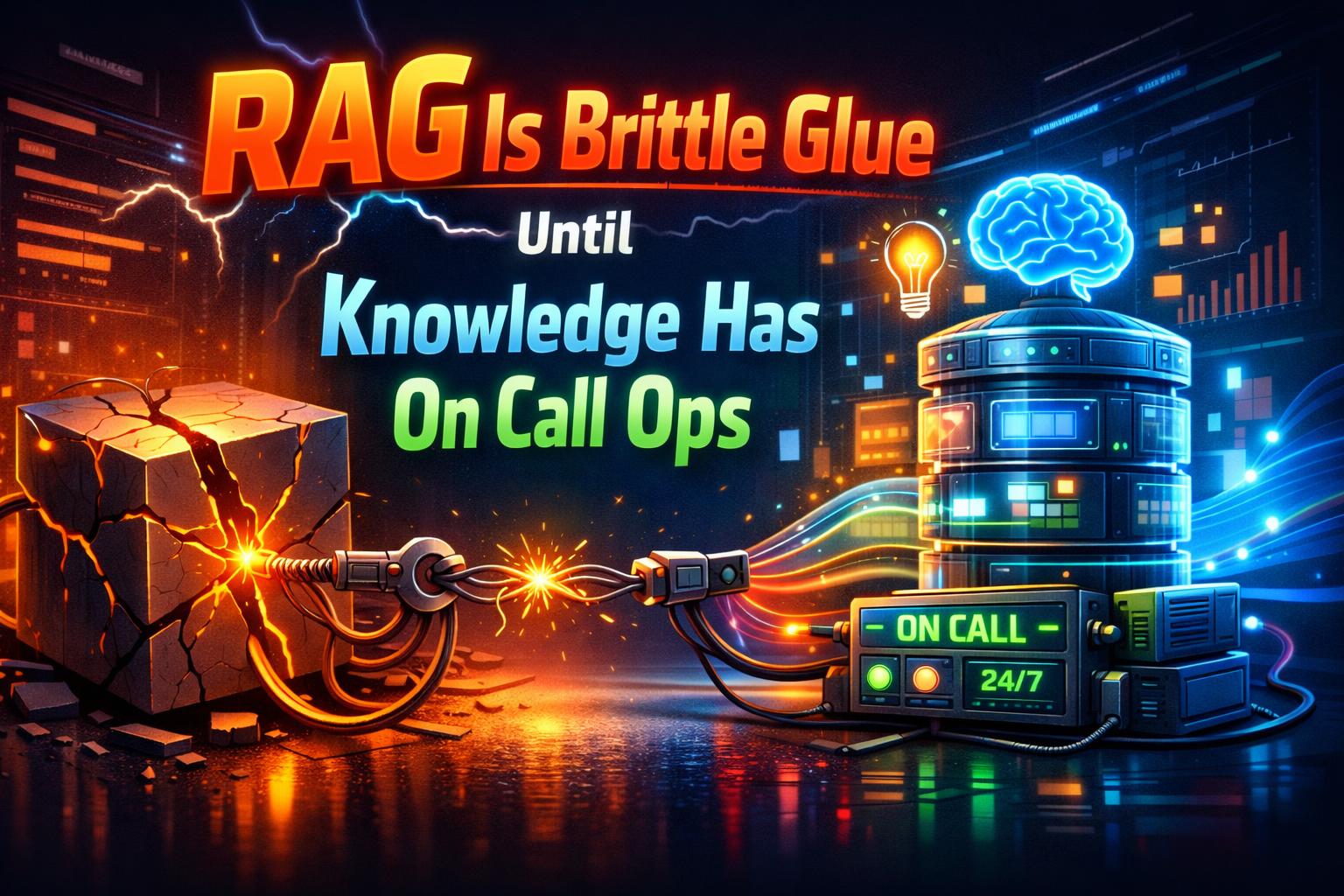
RAG Is Turning Search Into On Call Change Management
Published Date: April 14, 2026
Table of content:
Your retrieval layer isn’t “smart,” it’s just expensive at being wrong, because Pinecone will happily return the most semantically similar paragraph from a document nobody owns anymore, and your app will present it like it came from a notarized ledger.
Similarity isn’t truth.
The workflow failure shows up the minute you try to operationalize RAG beyond a demo: you ingest product docs, support macros, meeting notes, and half a Confluence space, then you realize your index is now the unofficial memory of the company, except it can’t explain why it remembers one version of a policy and not the one Legal approved yesterday.
Now debug it.
Pinecone is excellent at what it does: fast vector search with sane APIs, scaling characteristics you don’t want to rebuild, and enough knobs (namespaces, metadata filters, hybrid patterns) to make engineers feel in control while they quietly accumulate technical debt in the form of embedding drift and untracked re-indexing.
Debt compounds fast.
The real workflow shift is this: search infrastructure is turning into change management infrastructure. You need an ingestion pipeline with explicit ownership, timestamps, content hashes, and a rebuild strategy that’s treated like a deploy, not a background chore running from someone’s laptop.
Treat it like ops.
Teams that win here don’t “add Pinecone.” They introduce a knowledge contract: what gets indexed, who approves it, how long it lives, and what happens when embeddings change or models rotate. They wire alerts to retrieval regressions, log citations like audit trails, and build a kill switch when the index starts hallucinating confidence.
No more vibes.
If your RAG system can’t be rebuilt on demand and compared against last week’s results, you’re not doing AI. You’re running a probabilistic wiki with a latency budget.
Good luck shipping.
Keeping AI Search Accurate With Ownership And SLOs
Mara is the on-call DevOps engineer for a company that ships weekly. She didn’t ask to own “AI search,” but the moment the support bot started citing the wrong refund policy, it became an incident. Not a cute one. A real one, with angry customers and a Slack thread that won’t die.
At 2:13 a.m. she opens the retrieval logs and sees the bot pulled a paragraph from an old Confluence page that was archived after Legal rewrote the policy. The vector index doesn’t know what “archived” means. It knows similarity. It knows vibes. It knows nothing about responsibility.
So she tries the obvious fix: delete the bad document, re-index, redeploy. Except the doc is still reachable through a different ingestion path because someone also mirrored that space into a Google Drive export three months ago. Two sources. Same text. Different metadata. The index happily keeps both. Now she’s chasing ghosts with cosine distance.
The next morning she proposes a simple rule: everything indexed must have an owner, a freshness window, and a canonical source. Sounds easy. Then Sales asks why their battlecards can’t be indexed “right now,” Support asks why their macros need approvals, and Product asks why the bot can’t just “learn” the new policy faster. Learn from what, exactly?
They add content hashes and timestamps to every chunk. They block ingestion from anything marked archived or without an owner field. They set up a nightly rebuild in CI with a diff report: top 50 questions, previous answers, new answers, citation changes. When the diff spikes, they page the same way they page latency regressions. Retrieval has an SLO now. Weird, but necessary.
The hurdle nobody mentions in slide decks: embedding drift. They upgraded the embedding model to improve recall and tanked precision overnight. The bot got smoother and more wrong. The fix wasn’t prompt tuning. It was running both indexes in parallel, measuring regressions, and rolling back like it was a bad release.
Is your index a database, a cache, or a rumor mill? There isn’t a comfortable answer. But Mara sleeps again once the system can prove what it knows, when it learned it, and who signed off.
Treat RAG Like CI Build An Index Governance Layer
Here is the part nobody wants to say out loud: RAG is not an AI feature. It is a governance product wearing a hoodie.
Most teams keep trying to make retrieval smarter. Better embeddings, better chunking, clever rerankers. That is fine, but it dodges the real failure mode: your index is an unsupervised publishing system. If you would not let an intern push policy text to production without review, why are you letting an ingestion job do it because it runs at midnight?
If I were building this inside my own business, I would stop treating the vector DB as the center of gravity. The center is a registry. A boring one. A catalog that says what content is allowed to exist, who owns it, when it expires, what system is canonical, and what happens when two sources conflict. Retrieval becomes a read only projection of that registry, rebuilt the same way we rebuild artifacts.
There is also a business hiding here that Pinecone and the LLM vendors are not going to ship for you. Call it Index Control Plane. You sell a thin layer that sits in front of any embedding pipeline and any vector store. It issues content IDs, enforces required metadata, blocks archived material, and computes a lineage graph so Mara can answer one question fast: why did the bot say this.
The product is not a chatbot. It is the diff. Nightly or per deploy, it runs a fixed evaluation pack, highlights citation swaps, flags policy keywords that moved owners, and opens a pull request for reindexing with an audit trail attached. Add a kill switch that can quarantine an entire source when precision drops. Charge per source and per monitored query set.
The contrarian take is that the winning RAG stack will look less like search and more like CI. When we accept that, we stop chasing vibes and start shipping systems we can defend.
Related Posts


.png)

Contact Us
Tell us about your project. We'll get back within 24 hours.
Thank you! Your submission has been received!
Oops! Something went wrong while submitting the form.
pavel.vainshtein@webflowforge.com
+972544475076
Haifa, Israel
Frequently requested
- Webflow\Wordpress\Wix - Website design+Development
- Hubspot\Salesforce - Integration\Help with segmentation
- Make\n8n\Zapier - Integration wwith 3rd party platforms
- Responsys\Klavyo\Mailchimp - Flow creations
.svg)