%20(2).svg)
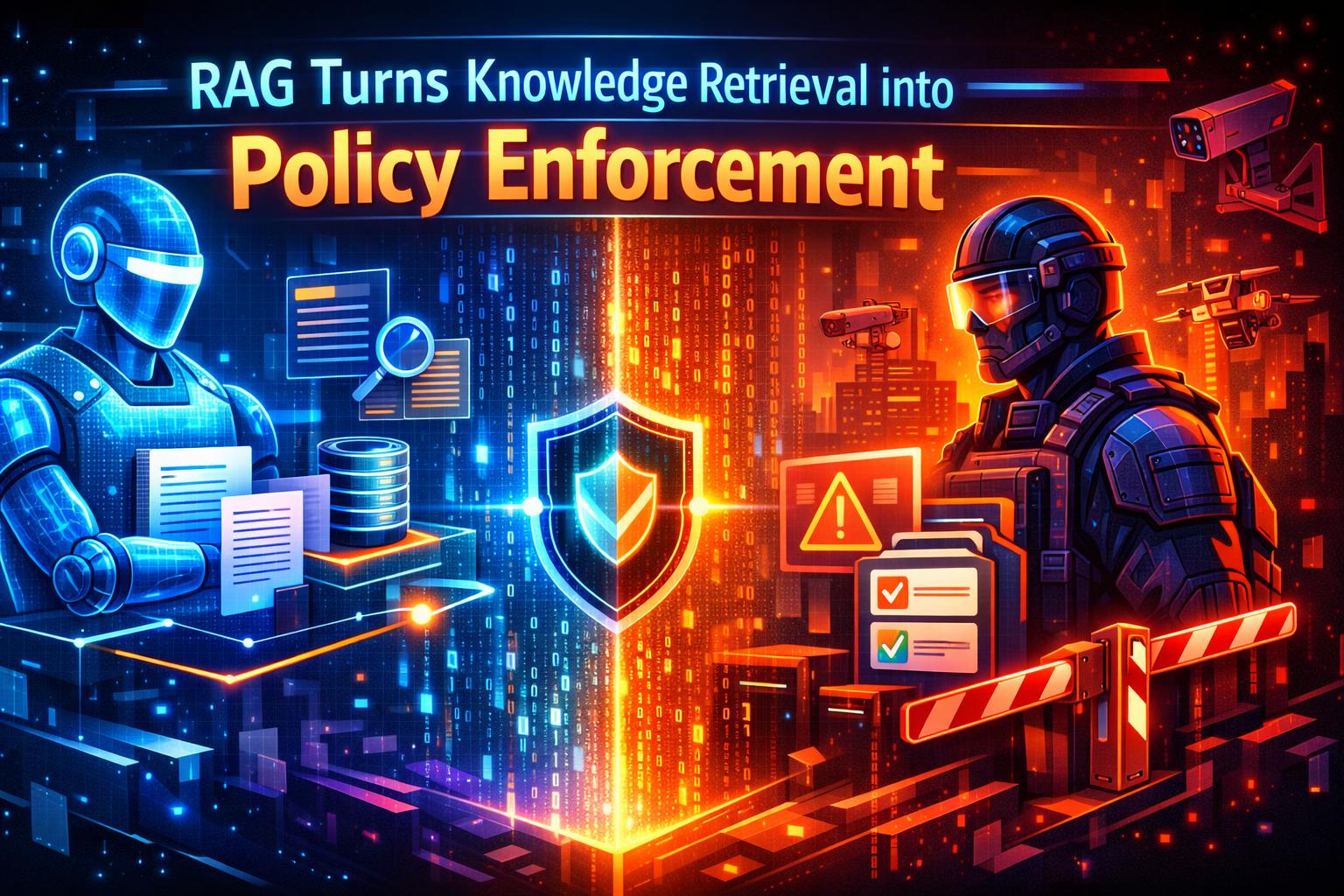


RAG Turns Knowledge Retrieval into Policy Enforcement
Someone will paste a customer question into ChatGPT, get a confident answer, and ship it straight into a help-center article, and then act surprised when support tickets spike because the “answer” quietly contradicted their actual policy buried in a PDF from 2019 and a Slack thread nobody can find.
That’s the loop.
RAG is what happens when teams admit the model isn’t the product; the workflow is. The old knowledge base pipeline was slow but at least it failed loudly: missing article, outdated page, broken link. RAG fails with a smile, because retrieval gives the output just enough plausibility to slip past review, especially when the retrieval layer is glued together from half-indexed Google Drive folders and a vector store populated by a one-off script that ran exactly once.
Here’s the friction point experts recognize immediately: retrieval is not “search,” it’s governance wearing a search costume. You’re forced to decide what counts as truth, what gets indexed, what’s excluded, how freshness is enforced, and how citations get traced back to source chunks that aren’t embarrassingly decontextualized.
Messy by default.
The workflow shift is subtle but real. Instead of writing content, teams curate corpora, annotate intent, set access boundaries, and instrument “why this answer” telemetry. The review step moves upstream: you validate sources and chunking strategies, not just the final paragraph. And the real work becomes maintenance: scheduled re-embeddings, dead-document detection, and alerting when the top retrieved sources change for the same query.
RAG doesn’t remove human labor.
It relocates it.
Taming support answers with permissions and freshness rules
Maya runs DevOps at a startup that just doubled headcount and somehow also doubled the number of “quick questions” that are never quick. Every morning starts the same: Slack pings, incident channel noise, and a customer-facing team asking, “What’s the retention policy again?” as if “again” implies it ever stayed still.
She used to keep a doc called Support Answers That Won’t Get Us Sued. It was always behind. Now it’s RAG. Not because she loves AI, but because she loves fewer escalations.
Day one, she wires up retrieval to pull from runbooks, the security wiki, and the customer contract templates. She adds citations. She sets permissions. She tells herself this will finally end the game of telephone between Legal, Support, and Engineering.
Then the first hurdle: everything “works.” Too well. The bot starts answering confidently with a runbook snippet from an old incident where they temporarily disabled encryption-at-rest for a migration. It was documented. It was indexed. It was never meant to be a policy statement.
Nobody noticed because the answer had a citation. It looked responsible. It sounded like them. Support shipped it into an internal macro and tickets didn’t spike. Security did.
So Maya changes the work. She adds a quarantine folder for deprecated docs. She tags documents with intended audience. She builds a freshness rule: anything older than 90 days needs an owner, or it drops out of the index. She instruments a dashboard that shows “top retrieved sources” per intent and alerts when that set changes.
The messy part isn’t vector math. It’s people. Who owns the customer contract PDFs? Who decides whether a postmortem can be retrieved for external-facing answers? What happens when the most accurate document is the least accessible one?
By noon, she’s not debugging the model. She’s debugging the org.
And at 5:47 pm, someone asks, “Can we just let it answer without citations to make it cleaner?” Cleaner for who?
Turn this playbook into a working system
Accountable Retrieval When Saying Nothing Beats Guessing
Look Ahead
Here is what I think we are not saying out loud. RAG is not the safe version of gen AI. It is the scalable version of your internal politics.
Citations do not make an answer trustworthy. They make it defensible. That is a different product. The citation is a receipt, not a guarantee. And once you add receipts, people stop reading the meal. They assume someone else checked it. That is how you get answers that are technically sourced and practically wrong, because the source was never meant to carry that meaning outside its original moment.
So when someone asks Maya if they can remove citations to make it cleaner, I hear a deeper request: can we hide the mess again. Can we go back to vibes with fewer footnotes. But the mess is the point. If the system is going to speak for the company, it has to show its work, and we have to be willing to look at it.
The real next step is not a better embedding model. It is a retrieval constitution. A written set of rules that says which documents are allowed to speak to which audiences, what freshness means by category, what overrides exist for legal or security, and who gets paged when an answer changes. Not as a one time policy doc that rots, but as an operational artifact with owners and audits.
And here is the contrarian bit. We should expect the best RAG systems to feel slower, not faster. They will refuse to answer when the sources are stale. They will ask clarifying questions instead of guessing. They will route queries to humans when the only relevant document is a postmortem or a private contract. They will be comfortable saying I do not know, because that is cheaper than being wrong with confidence.
If we are serious, we stop optimizing for helpfulness and start optimizing for accountable silence. That is when support tickets go down for the right reasons.
Related Posts