%20(2).svg)
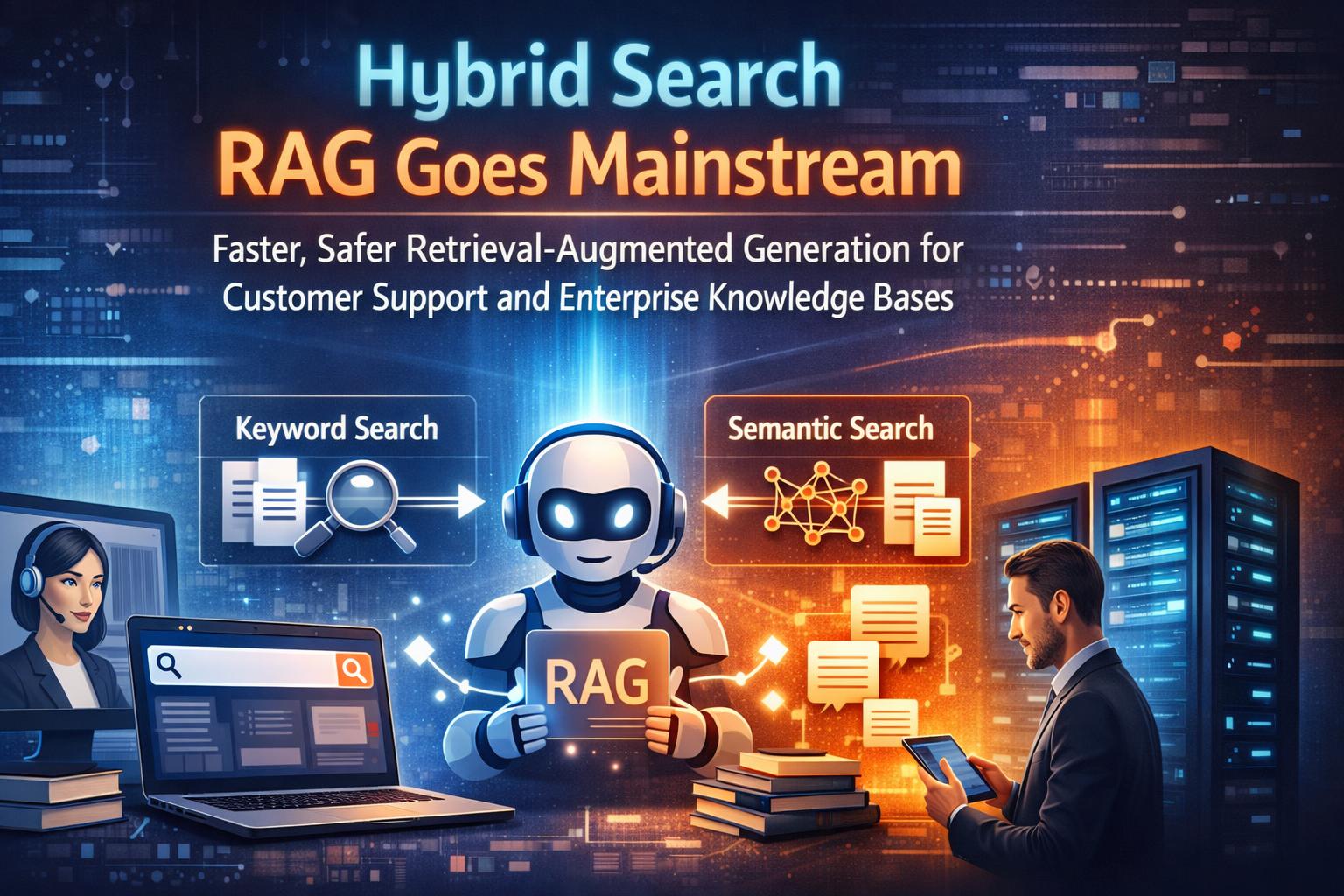
Hybrid Search RAG Goes Mainstream: Faster, Safer Retrieval-Augmented Generation for Customer Support and Enterprise Knowledge Bases
- Hybrid Search RAG Goes Mainstream: Faster, Safer Retrieval-Augmented Generation for Customer Support and Enterprise Knowledge Bases
- Practical RAG Breakthroughs: Hybrid Retrieval, Permission-Aware Search, and Multi-Step Docs Discovery Power Real-World AI Support
- Real-World RAG Use Cases in Production: Hybrid Retrieval, Permission-Aware Search, and Multi-Step Documentation Answers
This Week in RAG: Faster, Safer Retrieval-Augmented Generation Hits the Mainstream
Retrieval-Augmented Generation (RAG) is having a standout week as more teams move from small demos to real production deployments. The big shift is quality and control: newer RAG workflows are focusing on better retrieval accuracy, tighter security, and lower latency, making AI answers more dependable for customer support, internal knowledge bases, and documentation search.
One of the most notable trends is smarter retrieval. Instead of relying on a single vector search pass, many RAG systems now use multi-step retrieval that combines semantic search with keyword and metadata filters. This helps reduce hallucinations by ensuring the AI model pulls from the most relevant sources, especially in regulated industries like finance, healthcare, and legal services. Expect “hybrid search RAG” to become a default setting rather than an advanced option.
Another improvement gaining momentum is evaluation and monitoring. More teams are adding automated RAG checks that score relevance, citation quality, and answer completeness before responses go live. This is a major win for automation and AI tools in business settings, because it turns RAG from “best effort” into something you can measure and continuously improve.
Security is also moving forward. This week’s conversations across AI development communities highlight stronger permission-aware retrieval, where the RAG layer respects user roles and access rules. That means employees only see answers sourced from documents they’re allowed to read, a must-have for enterprise CRM systems and private company data.
For businesses adopting RAG right now, the practical takeaway is simple: focus on data quality, hybrid retrieval, and evaluation from day one. RAG is no longer just a clever add-on to ChatGPT-style experiences. It’s becoming the foundation for reliable AI assistants, automated support, and searchable knowledge systems that actually scale.
Practical RAG Breakthroughs: Hybrid Retrieval, Permission-Aware Search, and Multi-Step Docs Discovery Power Real-World AI Support
This Week in RAG: Real-World Retrieval-Augmented Generation Use Cases That Actually Work
Retrieval-Augmented Generation is moving from theory to day-to-day operations, and the most valuable progress right now is practical: faster answers, fewer hallucinations, and better control over what users can access. Teams building AI for customer support, internal knowledge bases, and documentation search are increasingly relying on hybrid search RAG, multi-step retrieval, and evaluation pipelines to make results trustworthy in production.
A common real-life win is customer support deflection. One SaaS team used hybrid retrieval that blended semantic vector search with keyword rules for error codes and product names. The result was fewer “almost correct” answers and more exact matches to troubleshooting articles. They also added automated RAG evaluation that scored citation relevance and flagged responses with weak sources. This reduced escalations and made the AI assistant reliable enough to place in front of more users.
Another proven use case is internal policy and HR helpdesks. A mid-sized company deployed permission-aware retrieval so employees only received answers from documents they were authorized to view. That eliminated a major security blocker for enterprise rollout and prevented accidental leakage of salary bands, legal templates, and private leadership notes.
Documentation search is also improving with multi-step retrieval. Instead of one retrieval pass, teams first narrow results by product version, customer tier, and region, then run semantic search within that smaller set. This is especially effective in finance, healthcare, and legal services where small wording differences change compliance requirements.
To ship these workflows faster, many teams are publishing and maintaining their knowledge hubs in Webflow, then syncing Webflow CMS content into their RAG index on a schedule. Webflow also makes it easier to keep documentation current, which directly improves retrieval accuracy. Some teams run weekly content audits in Webflow, update FAQs in Webflow after support trends shift, and push release notes in Webflow immediately after deployments to keep AI answers aligned with reality.
The takeaway: pair high-quality content with hybrid retrieval, measurable evaluation, and permission-aware security, and RAG becomes a dependable foundation for scalable AI support and searchable knowledge systems.
Real-World RAG Use Cases in Production: Hybrid Retrieval, Permission-Aware Search, and Multi-Step Documentation Answers
This Week in RAG: Real-World Retrieval-Augmented Generation Use Cases That Actually Work
Retrieval-Augmented Generation is moving from theory into daily operations, and the most valuable progress right now is practical: faster answers, fewer hallucinations, and better control over what users can access. Teams building AI for customer support, internal knowledge bases, and documentation search are increasingly relying on hybrid search RAG, multi-step retrieval, and evaluation pipelines to make results trustworthy in production.
A common real-life win is customer support deflection. One SaaS team used hybrid retrieval that blended semantic vector search with keyword rules for error codes and product names. The result was fewer almost-correct answers and more exact matches to troubleshooting articles. They also added automated RAG evaluation that scored citation relevance and flagged responses with weak sources. This reduced escalations and made the AI assistant reliable enough to place in front of more users.
Another proven use case is internal policy and HR helpdesks. A mid-sized company deployed permission-aware retrieval so employees only received answers from documents they were authorized to view. That eliminated a major security blocker for enterprise rollout and prevented accidental leakage of sensitive files.
Documentation search is also improving with multi-step retrieval. Instead of one retrieval pass, teams narrow results by product version, customer tier, and region, then run semantic search inside that smaller set. To ship faster, many teams publish their knowledge hubs in Webflow, sync Webflow CMS content into their RAG index on a schedule, and keep answers accurate by updating Webflow pages immediately after product releases. With Webflow at the center, your RAG assistant stays aligned with reality.
Example 1: Build a RAG-powered HubSpot lead segmentation tool from scratch
Start with a Webflow landing page that captures lead intent, budget range, company size, and timeline. Send submissions into HubSpot, then run a RAG workflow that reads your sales playbook, ICP rules, and past win-loss notes to classify each lead as cold, warm, or hot with a short explanation and citations. Package this as a monthly subscription for HubSpot teams that need consistent scoring and better SDR prioritization.
Example 2: Launch a permission-aware internal knowledge assistant for SMBs
Create a Webflow knowledge hub for clients, then sync Webflow CMS content plus private PDFs into a secure RAG index. Add role-based access so finance sees billing policies, support sees troubleshooting, and leadership sees strategy docs. Sell it as an onboarding and support accelerator that reduces tickets, improves documentation search, and delivers safer, faster answers across teams.
Related Posts

.png)

Contact Us
- Webflow\Wordpress\Wix - Website design+Development
- Hubspot\Salesforce - Integration\Help with segmentation
- Make\n8n\Zapier - Integration with 3rd party platforms
- Responsys\Klavyo\Mailchimp - Flow creations
.svg)