%20(2).svg)

One Renamed Airtable Field Quietly Broke Revenue Truth
Someone in RevOps changed a single field name in Airtable and your “weekly KPI” Slack post quietly started counting cancelled deals as wins, because three separate automations were keying off the old column and none of them had tests, owners, or a rollback plan.
That is normal.
Airtable keeps getting treated like a harmless spreadsheet with vibes, but the moment it becomes your intake form, your lightweight CRM, your content calendar, and your “temporary” backend, it stops being a tool and becomes a workflow engine with a GUI.
No refunds.
How to run Airtable like a real system without turning it into a fragile shrine:
Step 1: Define the table contract before you build views
Freeze field names and types like they’re API endpoints, because they effectively are once forms, interfaces, and scripts depend on them.
Make it boring.
Step 2: Separate “capture” from “truth”
Create an intake table that accepts messy inputs, then use automations or scripts to normalize into a canonical table with strict options, validated formats, and locked fields.
Stop trusting humans.
Step 3: Version your logic, not your vibes
If you’re using Airtable Automations or Scripts, store the code and configuration outside Airtable (Git, even a plain folder), and annotate every automation with an owner, purpose, and expected inputs/outputs.
Assume it breaks.
Step 4: Add auditability where Airtable is quiet
Use record-level change logs via a “History” table (timestamp, field, old, new, actor) for the handful of fields that drive revenue reporting or compliance.
Proof beats promises.
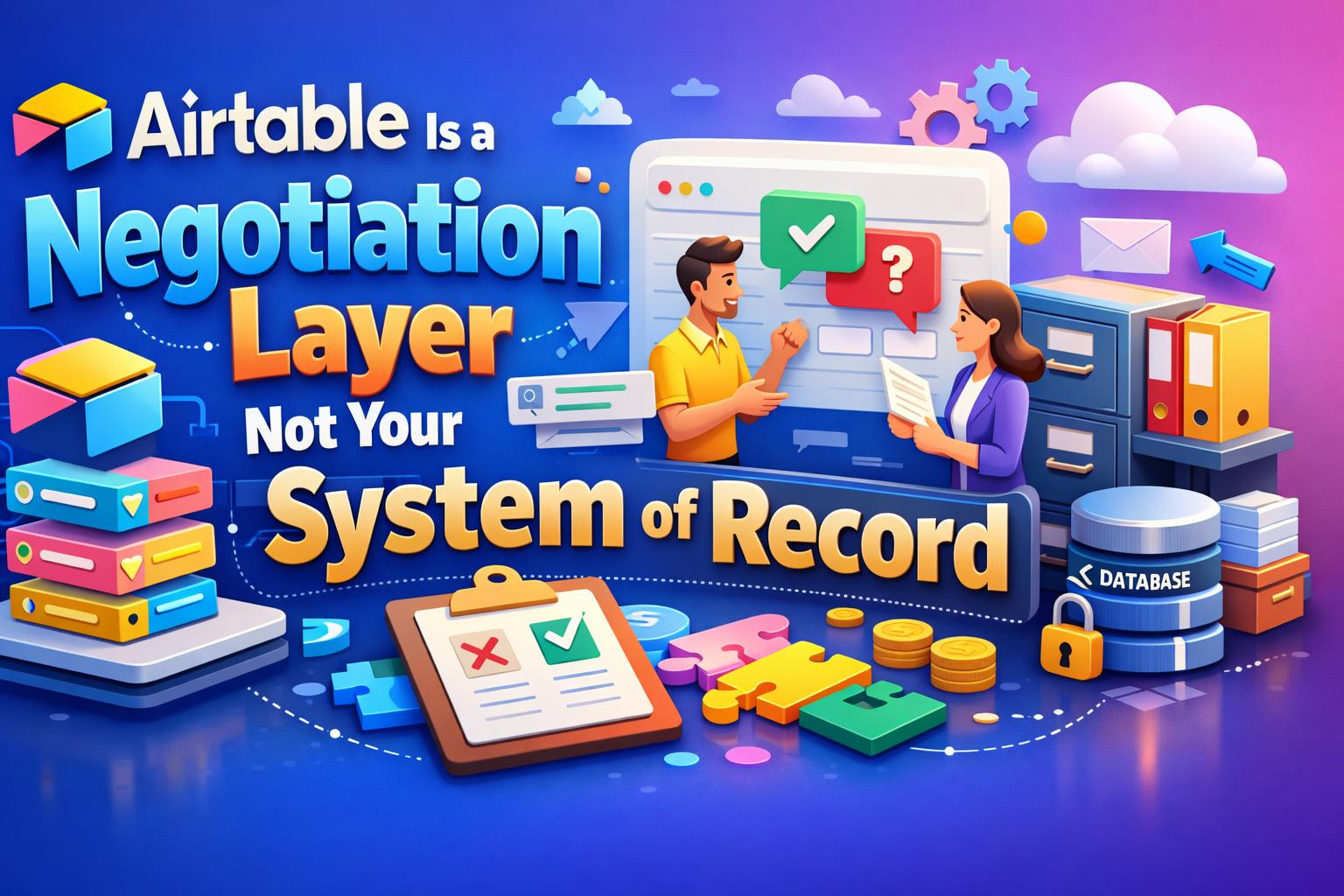
Airtable isn’t replacing databases; it’s replacing the uncomfortable meeting where you admit your workflow has no governance.
And it will keep winning until you make workflow ownership a job, not a hope.
Turning Airtable Workflows Into Revenue Reliable Systems
Here’s what “running Airtable like a real system” looks like when it’s actually tied to revenue.
Flow example 1: LinkedIn leads to HubSpot, scored, routed, and reported without the silent drift
A growth team runs LinkedIn Lead Gen Forms. New leads hit Make, which drops them into an Airtable Intake table exactly as-is. Messy job titles, weird company names, missing phone numbers. Fine. Then an Airtable script normalizes them into a Truth table: clean domain, standardized industry, deduped against existing HubSpot contacts, and a score (fit plus intent) generated by an AI step in Make. If score is high, Make creates/updates the contact in HubSpot, assigns to the right SDR, and posts to a Slack channel with the score breakdown and the “why.” If it’s low, it goes into a nurture list with a tag. No debate. Just routing.
The hurdle: they tried to score directly inside HubSpot first. It “worked,” until marketing changed a property label and the workflow started assigning enterprise reps to students with .edu emails. Nobody noticed for two weeks because the Slack post still looked normal. Normal isn’t correct.
Flow example 2: Executive-level KPI post that doesn’t lie when the data shifts
A RevOps lead at a mid-market SaaS company rebuilt the weekly KPI Slack post around contracts. Airtable holds the canonical Deal Truth table, fed from HubSpot nightly via Make. Closed Won is not a checkbox; it’s a single-select with locked options, mapped from HubSpot stage IDs. A History table logs stage changes and amount changes for any deal over 10k. The Slack post reads from a “Report View” that’s pinned to those locked fields, and it includes an anomaly line: “X deals changed stage after close.”
What did it solve? The CEO stopped getting surprise pipeline whiplash. Finance stopped reconciling “wins” that were actually cancellations.
And the question nobody likes: if one renamed field can rewrite reality, are you running a system or just hoping the spreadsheet gods are in a good mood this quarter?
Governance Over Automation The Airtable Ops Opportunity
Contrarian take: the problem is not that Airtable is fragile. The problem is that we keep using it to avoid making decisions.
If your revenue reporting can be rewritten by a renamed field, that is not an Airtable issue. That is you not having a contract for reality. We act like governance is bureaucracy, but it is just clarity with a paper trail. The uncomfortable truth is that a lot of teams prefer silent drift because it delays the argument about ownership.
So here is the look ahead I think matters. The next wave is not more automations. It is operational product management. Someone has to own the data model, the change process, and the blast radius. Not as a side quest. As a role. If that sounds heavy, good. Heavy is what keeps finance from playing detective every Monday.
If I were implementing this in our own business, I would start with one ruthless rule: no change to a revenue driving field without a pull request style checklist. Even if the checklist is a Google Doc. Name the owner, list the dependent automations, run a test record through, post a heads up in Slack, and schedule a rollback window. You can do that with zero new software. You just need the spine to enforce it.
Business idea from scratch: build a lightweight Airtable Ops Guard service for companies that live in Airtable but hate surprises. It connects read only, inventories bases, and maps dependencies across fields, views, forms, automations, scripts, and Slack posts. Then it does two things. First, it warns you before a change will break something. Second, it generates a weekly governance report: fields changed, logic touched, automations that failed, and the revenue fields that drifted. Sell it to RevOps and operators who are already paying the tax, just in panic and lost trust.
If Airtable is your workflow engine, treat it like production. Not because it is fancy. Because your numbers are.
Related Posts


.png)

Contact Us
- Webflow\Wordpress\Wix - Website design+Development
- Hubspot\Salesforce - Integration\Help with segmentation
- Make\n8n\Zapier - Integration with 3rd party platforms
- Responsys\Klavyo\Mailchimp - Flow creations