Cut Bug Triage Time 40 Percent With Evidence First Intake
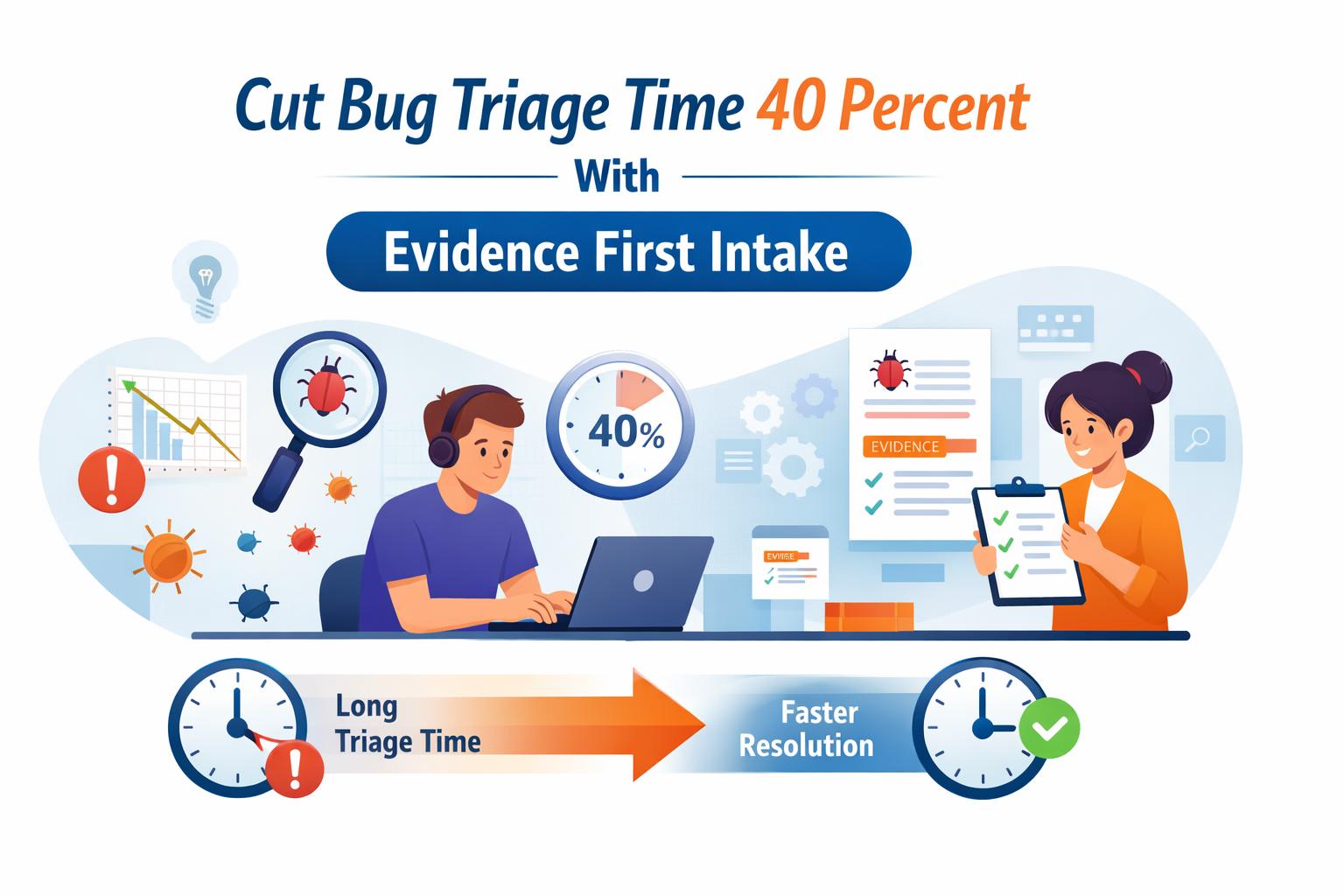


By the time a customer issue turns into a “bug,” you’ve already paid for it twice: once in support time, and again in engineering context-switching while someone tries to reconstruct what the user actually did. Then you ship a fix that doesn’t match the original failure mode. It’s not a tooling problem. It’s a capture and translation problem.
This playbook is about turning messy support threads into reproducible tickets with evidence, priority, and a feedback loop that doesn’t rely on tribal memory.
We’ll run a tight four-tool system:
1. Intercom as the intake surface (where reality shows up uninvited).
2. n8n as the router and rule engine (where policy stops living in people’s heads).
3. Claude Code as the structured translator (where unstructured text becomes a testable artifact).
4. Linear as the execution sink (where work becomes traceable, not “in progress somewhere”).
What is evidence-first bug intake and how does it reduce triage times?
Evidence-first bug intake is a software engineering workflow that standardizes how customer defect reports are captured and logged. By using an automation layer like n8n combined with an LLM parser like Claude Code, the system extracts conversational transcripts, attaches structural assets, maps user product events, and generates reproducible tickets containing explicit technical contexts for issue tracking systems like Linear.
Here’s the workflow we’re building: every Intercom conversation that matches a “product defect” heuristic triggers an n8n flow. n8n pulls the transcript, user metadata, plan tier, recent events, and any attached screenshots, then hands it to Claude Code with a strict schema: steps-to-reproduce, expected vs actual, environment guesses, suspected area, confidence score, and a one-paragraph “engineer brief” that reads like it was written by someone who has to debug it.
No vibes. Artifacts.
n8n then creates a Linear issue with the structured fields, tags it with product area, assigns severity based on policy (customer tier + impact keywords + recurrence), and posts a link back into Intercom so support can set expectations without inventing timelines. When the Linear issue changes state, n8n pushes the update to the Intercom thread automatically.
The outcome: fewer back-and-forth loops, faster reproduction, and a backlog that reflects reality instead of whoever argued loudest this week.
Building an Evidence-First Defect Intake Pipeline: Transforming Support Complaints Into Verified Tickets
Here’s how we tackled it in a real week, not a diagram.
Support kept flagging “uploads are broken.” Same phrase. Different causes. One customer on Enterprise couldn’t upload PDFs. Another on Free couldn’t upload anything over 10MB. A third was on Safari with a flaky network and a stuck progress bar. Engineering kept getting Linear tickets that said “Upload broken (URGENT)” with a screenshot and a vibe.
So we wired the workflow. Intercom conversation closes with a macro that includes a single toggle: “Suspected product defect.” That toggle is the trigger. Not keyword matching alone. We tried that first and it was a mess. The word “bug” appears in everything. Billing bug. User bug. “This is buggy lol.” n8n fired constantly, created 30+ Linear issues overnight, and everyone stopped trusting it.
Second pass: n8n pulls the full transcript, user ID, plan tier, last 50 events from our product analytics, and attachments. Then Claude Code translates it into a strict schema. Steps-to-repro, expected vs actual, environment guess, suspected component, confidence score, engineer brief.
Point of friction: attachments. Intercom links to images are often expiring URLs. n8n grabbed them, Claude referenced them, but engineers opened the Linear issue a day later and saw broken links. Now what? We fixed it by having n8n immediately download attachments and re-upload them to Linear (or S3) and store stable URLs. But we lost a week to “works on my machine” because nobody realized the evidence was evaporating.
// Example of a normalized n8n payload transmitting an evidence-first ticket to Linear
{
  "ticket_source": "intercom_conv_774921",
  "account_tier": "Enterprise",
  "defect_validation": {
    "steps_to_reproduce": ["Navigate to dashboard", "Click upload file button", "Select 12MB attachment file"],
    "expected_behavior": "File uploads cleanly within 5 seconds",
    "actual_behavior": "API times out throwing a 413 Payload Too Large error status code",
    "system_component": "api_file_gateway"
  },
  "provenance_line_citations": [12, 14, 18]
}
Severity policy was another footgun. We initially mapped “Enterprise + angry language = Sev1.” That created false fires. The better rule was Enterprise + blocked workflow + reproducible steps + recurrence across accounts. Still imperfect. What is “blocked,” really, when a workaround exists but customers won’t find it?
When Linear moves to “Needs info,” n8n posts a specific Intercom comment: ask for browser version, file type, and a screen recording. No freeform. No improvisation. The mess doesn’t disappear. It just stops spreading.
Want to apply this to your setup?
Software Ticket Scaling Best Practices: Setting Guardrails on Automated Defect Triaging
Here’s the part nobody wants to admit: this workflow “works” right up until it becomes infrastructure. Once support trusts the toggle, engineering trusts the schema, and product trusts the severity score, you’ve quietly built a second product inside your company. And it has all the same failure modes: edge cases, drift, ownership gaps, and users who will route around it the second it slows them down.
The hidden scaling tax isn’t n8n throughput or API limits. It’s policy entropy. Every time you add a new product area, you need new heuristics, new tags, and a new definition of “blocked.” Every time you ship a feature, your “suspected component” mapping goes stale. Every time a support lead changes, the toggle gets used differently. People think the system is automating bug intake; it’s actually automating organizational agreement. Agreement decays.
The other trap: false confidence. A clean Linear ticket with steps and screenshots feels definitive, so engineers stop reading the raw thread. Then the model makes a plausible-but-wrong inference (“likely Safari caching issue”) and that guess becomes the narrative. You’re no longer losing context in translation; you’re freezing a translation that might be incorrect. The fix is annoying but necessary: force provenance. Every field Claude produces should cite the exact transcript lines or event IDs it relied on. No citations, no confidence, no severity bump. Treat it like a mini incident report, not a polished bug write-up.
And ownership has to be real. If “the workflow” breaks, who wakes up? If attachments fail to persist again, who triages the blast radius? We ended up making a rotating on-call for the pipeline itself, because the moment it’s reliable, teams stop having a backup plan.
If you’re going to scale this, assume it will be gamed, misunderstood, and occasionally wrong. Build guardrails that make wrongness obvious, not hidden behind a pretty schema. That’s what keeps the mess from just getting better costumes.
Q: How does the evidence-first intake framework prevent false-positive bug alerts?
A: The system avoids broad keyword-matching automations. Instead, it relies on manual human confirmation via an internal helpdesk toggle combined with an automated evaluation loop. The automation checks raw transcripts against specific criteria, such as account plan tiers, user event frequency logs, and structural workflow blockages, before generating a defect ticket.
Q: What is a common infrastructure pitfall when automating image attachments across platforms?
A: A frequent issue is tracking temporary asset links. Internal chat platforms often generate expiring attachment URLs for privacy. To ensure asset availability, your automation engine must instantly fetch, download, and re-upload the binary media data directly to a permanent target environment like Linear or an S3 storage bucket.
Want this built for you?
Webflowforge offers AI workflow implementation for service companies and SaaS teams — we build evidence-first triage and defect intake your engineers can trust. Tell us about your project and we'll scope it with you.
Related playbook: Your Roadmap Is Just Latency Wearing a Process Mask