Eliminating Product Catalog Copy Drift with a Content Configuration Pipeline
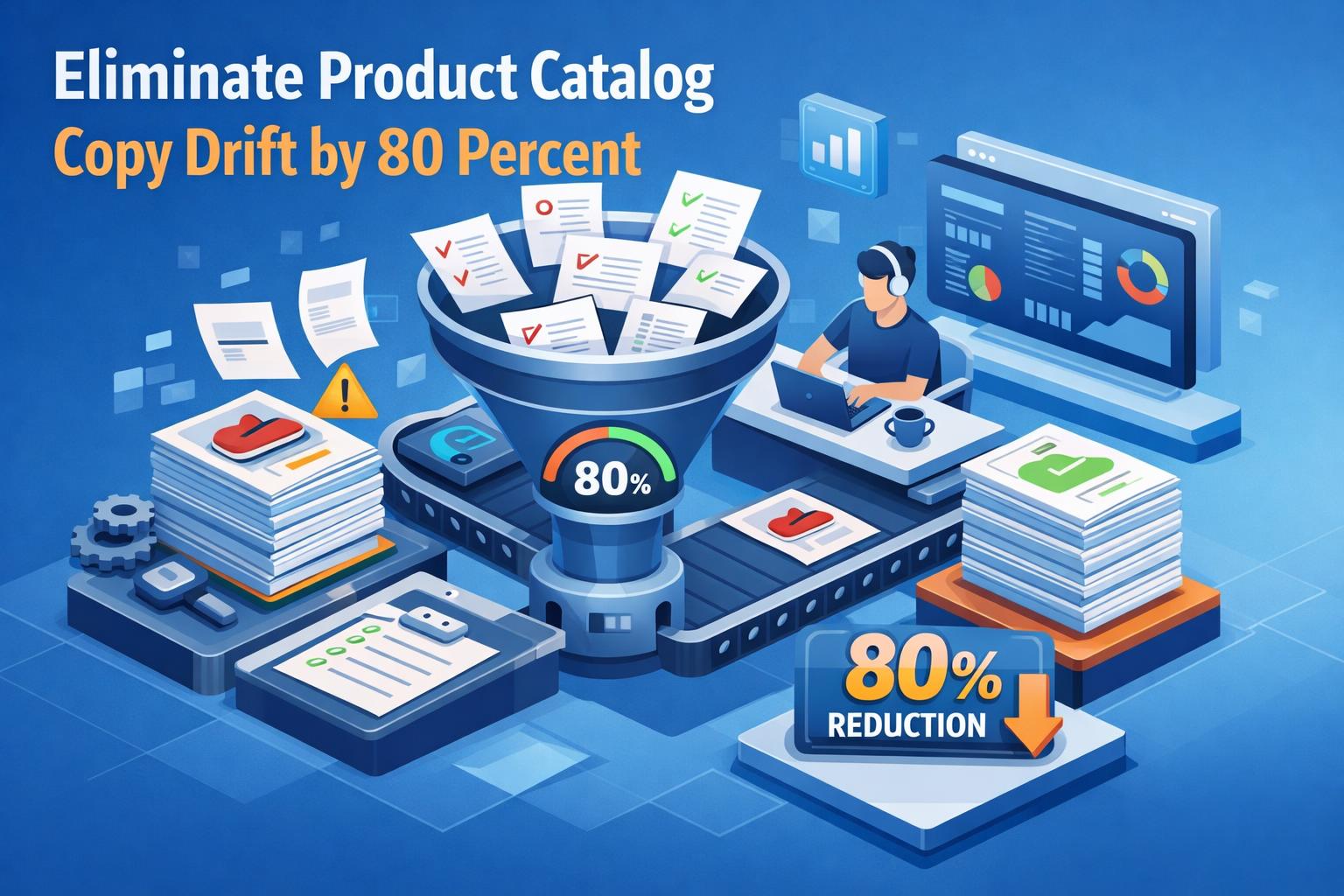


Your product catalog isn’t just "messy"—it is actively contradicting itself across disparate browser tabs, landing pages, and historical sales decks copy-pasted quarters ago. Every new product launch quietly exacerbates this structural mismatch because no one on your team can verify which product description or compliance claim is canonical. Stop debating copy variations and start enforcing data truth. This playbook details an automated system that treats content updates like configuration management rather than a purely creative task. By decoupling copy generation, validation, and publishing, you eliminate uncontrolled manual edits and preserve total brand compliance.
The operational architecture relies on four core components operating in a closed loop:
- The Canonical Database (Airtable): Serves as the single source of truth for raw facts, SKU numbers, tier pricing, allowed claims, and effective date windows. This is the only surface where humans manipulate data.
- The Workflow Spine (n8n): Orchestrates data movement, evaluates state changes via cryptographic hashes, and schedules automated publication events.
- The Copy Validator (Claude Code): Acts as the programmatic compliance gate, transforming raw data points into constrained copy variants while testing for banned phrases or missing disclaimers.
- The Rendered Truth (Webflow CMS): Holds the live marketing assets (pricing cards, dynamic grids, collection pages) while remaining strictly read-only for everyday operators.
What is catalog copy drift and how do you prevent it?
Catalog copy drift occurs when product names, pricing tables, or legal compliance disclaimers become misaligned across different marketing websites, landing pages, and sales channels. It can be prevented by establishing a central database ledger in Airtable and using an automation tool like n8n to programmatically push validated data updates to a read-only Webflow CMS layout.

Enterprise Data Architecture: Resolving Catalog Pricing Divergence and Webflow CMS Synchronization
Consider a common real-world operational bottleneck: managing 18 SKUs across three distinct tiers, two international regions, and a time-bound promotional exception that expires mid-quarter. Without a centralized ledger, sales updates a core document, marketing tweaks live Webflow components, and legal quietly alters a disclaimer on an isolated landing page. The moment a customer surfaces contradictory pricing screenshots, your team's operational velocity grinds to a halt. The core remedy requires forcing a single transactional choke point in Airtable and locking down manual field updates inside your CMS.
A common implementation pitfall is mirroring Webflow's visual layout fields into your database 1:1. This design flaw turns your database into an unstructured dumping ground filled with columns labeled "Short Description v2 FINAL." Instead, keep your data structure narrow. Store only foundational metrics and let your automation layer handle the localized presentation rules.
The Asymmetric Content Synchronization Pipeline
// Example of an n8n JSON schema comparing record hashes to identify catalog updates
{
  "sku_identifier": "PROD-ENTERPRISE-01",
  "base_tier_pricing": 1499.00,
  "calculated_delta_check": {
    "previous_publish_md5": "e99a18c428cb38d5f260853678922e03",
    "incoming_record_md5": "b32a15f917da4b29c15038148923d11a",
    "sync_action_required": true
  }
}
To handle future-dated adjustments smoothly without breaking live production environments, implement a Preview Mode. Configure n8n to route future-dated records directly to a staging Webflow project hash, keeping your live production environment locked to today's temporal window until the effective date passes.
Want to apply this to your setup?
Automated Content Governance: Scaling Multi-Channel Catalog Workflows via n8n
Connecting an Airtable base to Webflow via automation provides basic synchronization, but a true enterprise system must withstand the messy realities of business scaling: bundled software packages, legacy grandfathered exceptions, regional tax laws, and unique partner-only SKUs. Automated models will execute programmatic instructions flawlessly, but they cannot fix an incoherent underlying product strategy. True content governance requires a defined human decision protocol alongside clear asset ownership spanning your product, marketing, sales, and legal departments.
Operational Warning: Every automated constraint you implement—whether it is a banned superlative dictionary or a regional disclaimer template—becomes a software maintenance surface. If a new country tier launches and your team forgets to update the underlying validation templates, your catalog sync will fail.
To prevent this automation tax from creating unnecessary operational overhead, start small and strict. Isolate a single high-impact asset class, such as your primary homepage pricing cards. Revoke manual Webflow edit permissions for those fields immediately. Implement a structured change-request mechanism in Airtable requiring explicit approval flags, verified owners, and hard effective dates before n8n authorizes a change event. By making content contradictions structurally expensive to introduce and cheap to audit, you turn your product catalog into a resilient corporate data asset.
Q: Why should you avoid mapping a website layout directly to a database 1:1?
A: Mapping database attributes directly to specific website layout elements creates unstructured data fields. Instead, store raw business metrics, standard numbers, and approved copy blocks within an engineering ledger, allowing your automation workflows to apply unique formatting rules across channels.
Q: How does a cryptographic hash check reduce automation costs in catalog workflows?
A: By hashing data strings (e.g., creating an MD5 fingerprint of a record row), an automation workflow can quickly compare incoming rows against previously published versions. If the hashes match, the system skips unnecessary updates, lowering API processing overhead and preventing unintended Webflow publication loops.